About this example: Priya is an illustrative composite, not a real person. She's built from the kind of case a Big 4 consultant going for manager typically makes, so the numbers are realistic, not real. Swap in your own evidence, because the panel wants yours.
I'm Kajol Phadnis. I wrote a promotion case every time I went up at Deloitte, and the difference between a case that lands and one that doesn't is rarely the person. It's whether the evidence is easy to see. Here's what that looks like on the page.
Meet Priya
Priya is a consultant in a customer strategy practice at a Big 4 firm, four years in, working mostly on retail and consumer clients. She's going for Manager. Her firm assesses manager candidates on four things: client leadership and delivery, people leadership, business development, and commercial acumen.
1. The headline
One sentence at the top, written as a statement, not a request:
“I’m ready for Manager because I’ve run the loyalty workstream end to end for 7 months, with my Partner supporting my case.”
It names the level, gives the single strongest proof and says who backs her, in under 25 words. It follows the headline formula I use in every case: “I'm ready for [next level] because I'm already operating at it — [one line of the single strongest proof].”
2. Criteria, mapped to evidence
Each criterion gets one piece of evidence, ideally with a number:
| Criterion | Priya's evidence |
|---|---|
| Client leadership & delivery | Ran the grocery loyalty relaunch workstream day to day for 7 months |
| People leadership | Led a team of 4 (2 analysts, 2 contractors); coaches the graduate intake |
| Business development | Co-wrote the proposal that won a £1.2m follow-on |
| Commercial acumen | Her development area: shadowing bid pricing now (see part 6) |
Notice the last row. She doesn't pretend. A weak criterion, named and with a plan, reads as self-aware. Hidden, it reads as a gap the panel found for her.

3. Impact, in numbers
- £2.1m revenue influenced across the two programmes she worked on this year
- £1.2m follow-on won, from a proposal she co-wrote
- A reusable diagnostic toolkit she built, picked up by two later projects
Every line says what changed because of her. None of them says “worked on” or “supported”.
4. Proof she already works a level up
The strongest part of Priya's case is time. She's been doing the manager's job on the loyalty workstream for seven months: running the plan, preparing the steering committee and managing the team. That makes it a pattern, not a one-off, which is exactly what a panel wants to see.
5. Visibility and who backs her
Her Partner is sponsoring the case, and she's made sure the Retail practice lead knows her work. She also has short written quotes ready from the client and from someone she's managed, because named feedback carries more weight than her own description of herself.
6. The gaps, handled honestly
Commercials: pricing and margin. Her plan: shadow the pricing on the next bid with the engagement manager, and finish a finance course by December. One line each for the gap and the plan.
7. The ask and the 90-day plan
The case ends by restating the ask and showing what she'll do in her first 90 days as a manager, so the panel can picture her in the role:

Why this case works
- The headline does the work. A panel member who reads only the first line already knows the claim and the proof.
- Every criterion has evidence. Including the weak one, with a plan attached.
- It's short. A handful of slides. Panels skim, so the numbers sit where they'll be seen.
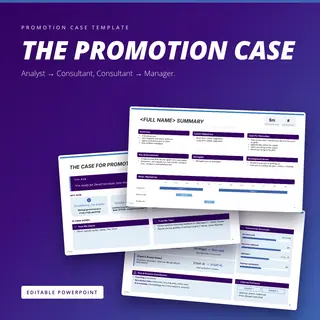
Build yours with the Promotion Case Template
This is one format. The template gives you both, as twelve editable slides with every placeholder in brackets. Building Priya's from scratch takes a weekend; with the template, an evening.
Where to start
Get your firm's criteria for the next grade in writing, then fill in part 2 first: one line of evidence per criterion. The rest of the case builds from there. For the full method, read how to build a promotion case, and for the grade itself, how to get promoted from consultant to manager.